


 4 minutos de lectura
  Listen to article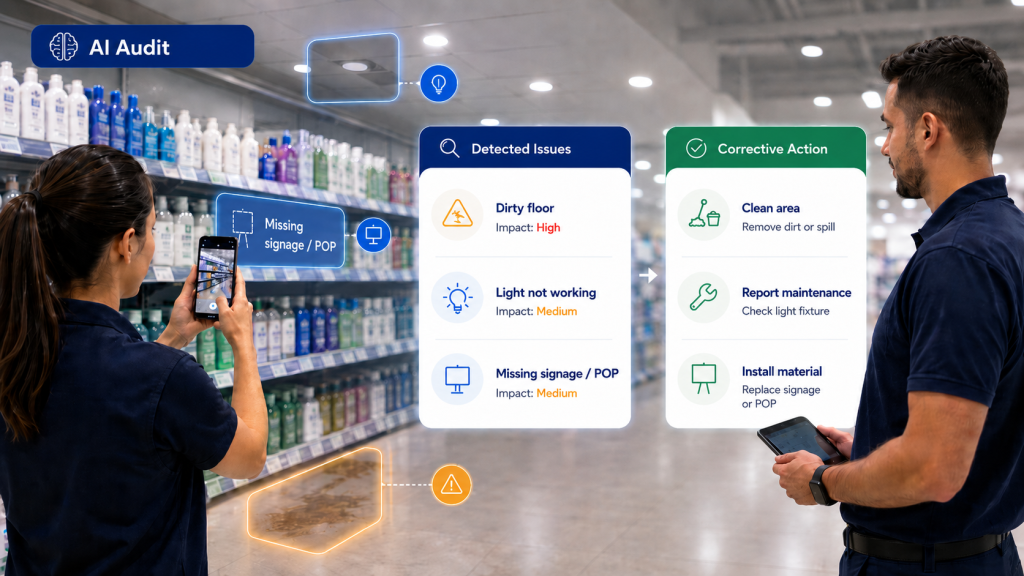
Most retailers run audits. Few know what happened to the findings from the last one. The checklist captures. Still, the information your team gathers in-store rarely reaches the people who need to act on it in a structured way. Whether AI-powered retail audits deliver real impact has less to do with data collection and more to do with what happens after your team puts the phone away.
The Finding That Got Lost in the Group Chat
It’s 11 a.m. The floor supervisor wraps up a walkthrough and spots a problem with the campaign display: the POP material isn’t in its designated spot. They take a photo, send it to the area WhatsApp group, and move on.
Within minutes, the thread fills with other messages, and the finding is buried.
Yet no one receives it as an audit deviation. No one classifies or prioritizes it. No one routes it to the right person. A few days later, someone visits the store. The display is still wrong.
That’s the real bottleneck. Not a lack of audits, but a finding with nowhere to go. Without a clear destination, the effort your team put into detecting it goes to waste.
What Changes When AI Enters the Auditing Process
Forrester makes this clear in its analysis of automation technologies for retail: the AI that operates behind the scenes generates greater operational impact than the AI facing consumers. Anomaly detection, computer vision, and internal process automation offer the highest return, and are also among the most underfunded tools in retail.
In practice, AI-powered retail audits aren’t just digital checklists. What changes isn’t the medium, from paper to mobile: it’s the logic behind the process. Rather than have your team log and archive, the platform analyzes, classifies, and determines in real time what to do with each finding.
As a result, the process no longer depends on someone remembering to check a shared folder or a group chat.
From Image Analysis to a Structured Report
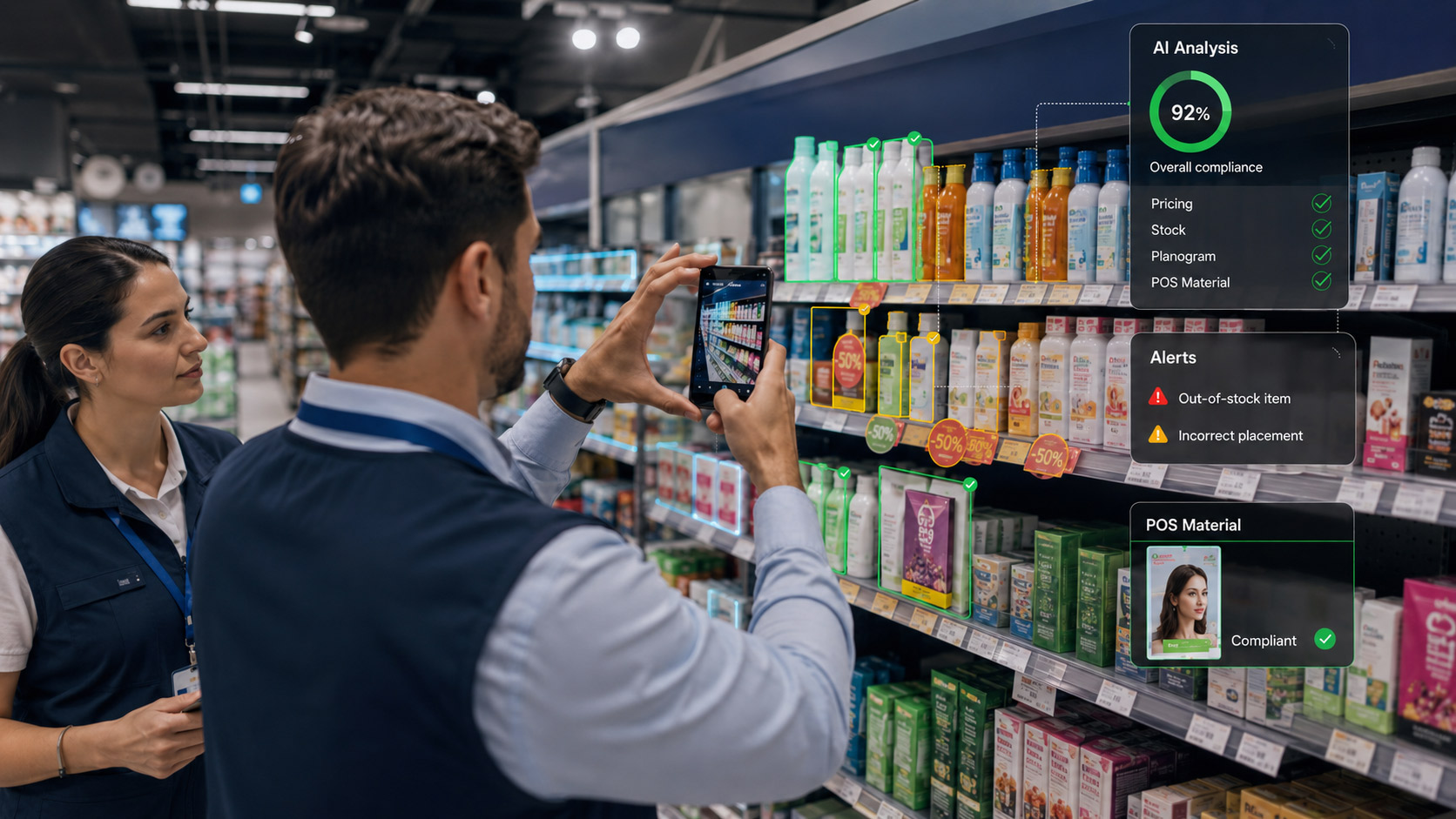
When your team conducts an audit with image capture, AI analyzes the recorded images: whether the display meets the standard, whether items are missing, and whether the setup matches the active campaign specs.
And it runs immediately, as the task is completed rather than after the fact.
According to Gartner, in-store computer vision is a key enabler of operational execution and visual standards compliance on the floor. Moreover, its adoption, combined with role-specific AI, will be one of the defining factors in retail chain profitability in the years ahead.
Instead of a photo log, the output is a structured Action Recommendation: which store, which area, what deviation the AI detected, and what needs to be done to fix it. The “what do we do about this?” question answers itself.
How That Report Drives Corrective Action
A recommendation no one acts on is as valuable as a finding in a group chat.
That’s why the platform doesn’t stop at analysis. When AI identifies non-compliance and delivers a recommendation, the system can escalate it, routing it to the right person with the context needed to act, and tracking follow-up through resolution.
This way, the full cycle is on record. The store manager knows what to fix and why. The operations director sees compliance status across the entire network. And the team stops managing findings manually so they can focus on resolving them.
That closed loop, intelligent detection and structured escalation, is what reduces the time between finding and correction. In operations where Frogmi supports this process, teams report up to a 75% reduction in management time. Not because more people are involved, but because every identified non-compliance has a clear path to resolution.
What Your Team Needs for AI-Powered Retail Audits to Scale Across the Network
Of course, one well-audited store doesn’t give you network visibility. And the most costly problems in retail, such as standards non-compliance, off-spec displays, and campaign execution gaps, happen at scale.
For AI-powered retail audits to work beyond a pilot, the platform needs to consolidate findings from 50 or 500 stores using the same logic. Your field team captures. AI analyzes and recommends. The system escalates and tracks. The report reaches the people who need it.
Without that consistency across stores, what you have isn’t operational intelligence. It’s fragmented data that someone has to piece together, store by store, before any decision can be made.
Spotting a problem is a start. Getting it to the right person, with the right context and in time to act, is where the real work happens.
Not by adding more checklists, but by connecting what your team already captures to the system that decides what to do next. See how Frogmi closes that loop.


