Why Retail Technology Fails to Deliver Results
Listen to article

9 out of 10 retail chains are actively investing in solutions to optimize store operations. Execution problems persist anyway. Across small and large chains, in established and emerging markets, across nearly every retail format. That gap deserves an honest look: why retail technology fails to deliver results, even when the investment is real.
The blind spot is rarely the budget. More often, it is fragmentation: tools running in parallel that never add up to a smarter operation.
The number that surprises: almost everyone is investing, but results are far from equal
Research shows that 92% of retailers are actively investing in solutions to optimize store operations. But the results tell a different story: there is a wide gap between chains that see returns and those that do not, and it keeps growing.
Retail chains with the highest sales growth are 482% more likely to identify as early adopters of technology. Chains leading in profit growth invest in store IT at a rate 460% higher than laggards, and report 343% higher agreement that technology delivers ROI within 12 to 18 months.
These figures do not point to a spending problem. They point to something more specific: integration. The capacity to connect systems so that data flows where it is needed. What defines outcomes is not how much is invested. It is the type of system chosen.
Why retail technology fails to deliver results when data stays fragmented
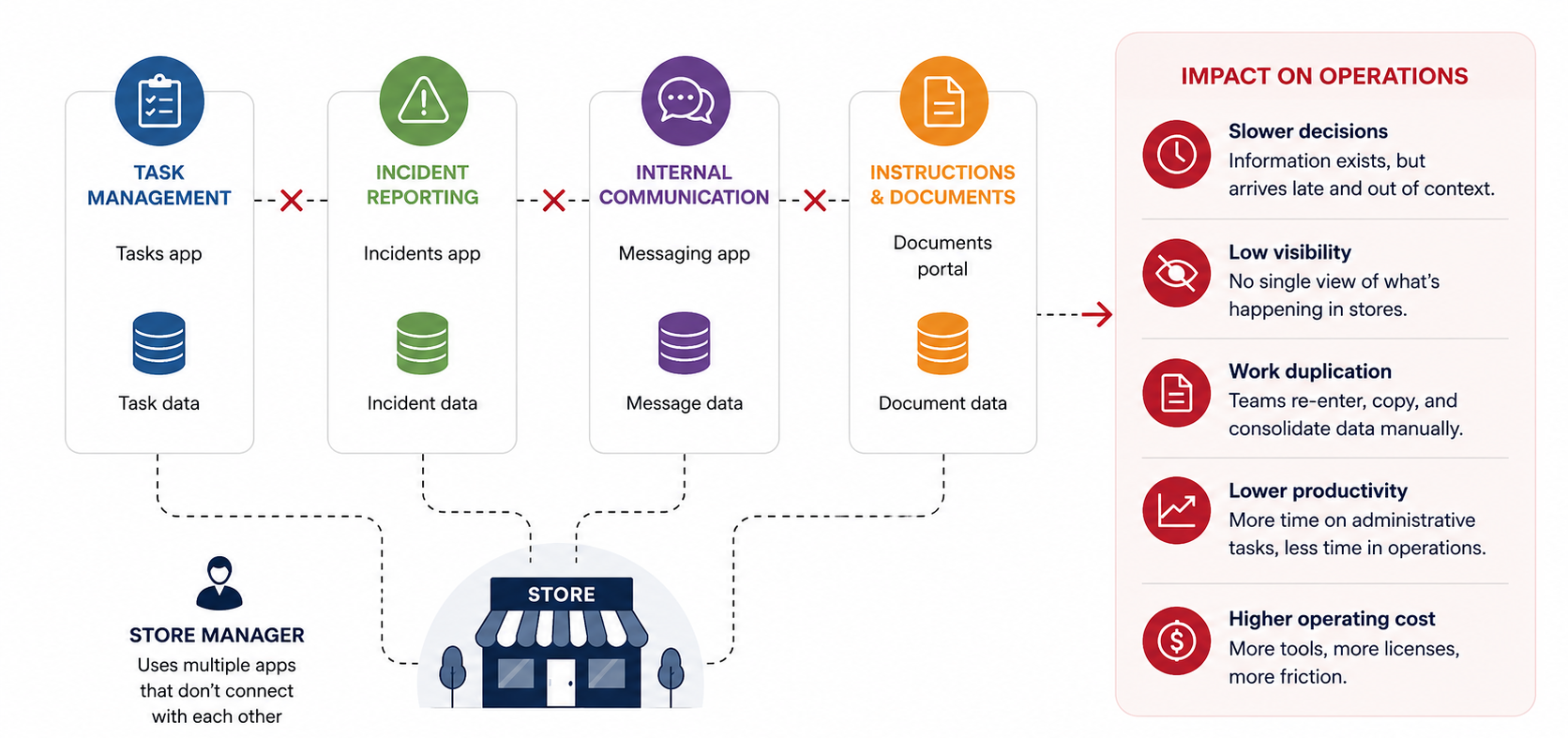
Picture this. The store manager uses one app to manage tasks, another to report incidents, and a third to receive instructions from headquarters. Each system generates data. None of them shares it.
The outcome is predictable. The regional manager spends hours pulling together information that already exists somewhere in the system. Decisions arrive late. Visibility gets lost along the way.
In this scenario, adding more technology does not solve the problem. It multiplies it.
Every additional system creates another silo. And silos do not cancel each other out; they pile up. Many organizations end up with more tools than ever and less clarity about what is actually happening across their stores. The accumulated cost of that friction is measurable.
The difference between connected tools and isolated ones
An isolated tool solves a specific problem. A connected tool changes how the entire chain operates.
The clearest example is operational traceability. A supervisor completes a store audit. That result automatically generates a task for the right team, with the necessary context and documentation attached. No manual handoff needed. The process no longer depends on someone spotting it, copying it, and passing it on.
In practice, a single finding can trigger an alert, assign a task, and notify the right team simultaneously. Not the next day. Not after the daily report comes in. Right then.
Without that connection, the data exists but nothing moves. Operations that do not act on their own data do not have real visibility. They have files.
For operations teams, that is the distinction that matters: tools that generate information the rest of the chain can actually use, when it is needed.
What separates leaders from the rest (and it is not the budget)
Retail chains that lead on results do not necessarily have the largest budgets. They have something more valuable: coherence across their systems.
Their tools for task management, audits, communication, and incident handling share data. Information flows from one system to the next without anyone having to translate, consolidate, or manually forward it. The result: visibility in real time, clear instructions for store staff, and a full view of the network for leadership, without waiting for end-of-day reports.
It also means that when headquarters launches a campaign, execution status is visible in real time: which stores completed it, which ones are off track, and which locations need follow-up. No calls required. No waiting until the end of the week.
That coherence is not purchased with more technology. It is built by choosing tools designed to integrate and ensuring data flows between them. This becomes even more critical when AI enters the picture.
Where to start when the technology is there but the results are not
When a store network already has systems in place but the numbers do not reflect that investment, the most likely diagnosis is not that the tools are failing. It is that each one is solving its own problem without talking to the rest.
In that case, the starting point is mapping what data each system produces, then asking: does it reach the team that needs it, at the moment they need it, without manual steps in between?
When that connection does not exist, the answer is not to open a vendor catalog. It is to pause and map what is already there, and what is not yet talking to anything else.
Platforms like Frogmi are built to be that integration layer: task management, audits, communication, ticketing and incident management, and document management in a single operational flow. Every data point generated in the store triggers the right process, with no manual steps in between.