


 5 minutos de lectura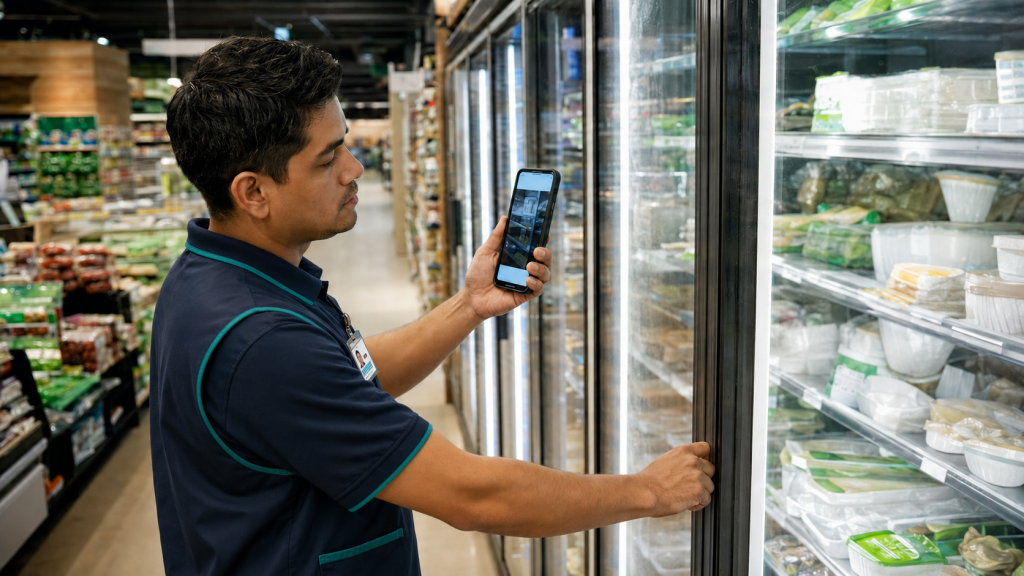
AI made it to the office. Now it’s the store’s turn. Picture someone on your store team walking down an aisle. They pass a refrigerator and notice it isn’t cooling properly. They spot the problem in a second. The hard part comes right after: who do I tell? Is this a maintenance issue? Do I log it in the app? Under which category? What priority do I give it?
More often than not, the issue simply never gets reported because reporting it takes real effort. That is exactly why AI incident management in retail matters so much: it can lift that weight off your team.
For years, retail put nearly all of its technology in the corporate office: forecasting, assortment planning, dashboards that summarize thousands of stores before lunchtime. Yet we ask the opposite of the person standing in front of the problem. Instead of giving them a tool that helps, we hand them the decision: classify it, notice everything that matters, and guess which team should take it on.
We have it backwards. The real opportunity is bringing artificial intelligence into the store, right to the point where the problem is spotted. And to understand why that matters so much, it helps to see exactly what it costs today when frontline staff carry that decision alone.
Why reporting an issue costs more than it looks
Reporting a problem or incident carries a real cost, and the numbers back that up.
First, there’s the time lost. McKinsey found that the average employee spends close to 1.8 hours a day just searching for and organizing information, nearly one-fifth of the workday. In stores, it’s worse because the right tool often doesn’t even exist. According to Deloitte, only 23% of frontline workers feel they have the technology they need to do their job well.
Then there’s communication. When someone guesses the wrong category, the task lands with the wrong team, bounces back, gets re-explained, and falls behind schedule. Lost time, messages that never arrive, and problems that go unresolved: it all starts at the same point, asking the person with the least time to spare to make a decision the system should be making instead.
Our idea: Getting the form out of the way
Frogmi rebuilt that approach around a much simpler idea. Instead of the usual form with more fields and more categories, frontline staff get a single box to write in. They describe what they see and snap a photo. That’s it.
From there, in-store AI takes over: it reads the text, examines the image, identifies the equipment or machine involved, assesses the severity, and routes the case to the right team. The person never had to learn the categories. The system already knows them.
We half-jokingly call this “standardizing the standard.” Every company has rules, procedures, and protocols. They live in manuals and training sessions, and they break down the moment they depend on someone, rushed and in the middle of a shift, remembering to apply them correctly. AI-driven routing, by contrast, applies the rule every time, no matter how the problem was described.
What sets us apart: One report, several paths at once
Back to the refrigerator. The employee writes, “the fridge isn’t cooling.” To them, it’s a maintenance issue and nothing more. But the photo shows product stored at a temperature that’s no longer safe.
AI-driven routing catches both. Instead of opening a single case, it opens several at once, each with its own owner and its own progress:
- Maintenance handles the equipment repair.
- Quality reviews the product at risk.
- Compliance logs what happened and how it was handled.
As a result, three teams work in parallel on something the employee experienced as a single problem. And the case doesn’t close until every path does.
This pattern shows up everywhere. A roof leak, for example, is a maintenance issue, a safety issue, and sometimes an electrical issue as well. An expired fire extinguisher or a blocked exit touches safety, facilities, and compliance all at once. Almost no real-world problem fits into a single box.
Why this shift matters
When a problem is routed correctly and on time, it doesn’t get the chance to grow. That’s where the real savings come from.
In food safety, for example, the biggest risk for a store is losing customer trust. A NielsenIQ survey found that 68% of consumers would stop buying from a brand after a food safety incident. Catching a cold-chain break in time protects exactly what keeps customers coming back: the trust.
Something similar happens with maintenance. The U.S. Department of Energy estimates that an emergency repair costs three to five times more than a planned one. The sooner the right person hears about it, the cheaper it is to fix.
Then there’s traceability. When something goes wrong, the question is always the same: when did you find out, and what did you do about it? With AI-driven routing, the answer builds itself from the moment the issue is reported. What’s more, regulations like the FDA’s FSMA 204 will require producing those records within 24 hours. Having a clear, ready history is no longer a nice-to-have.
It lives on the phone, so it actually gets used
None of this works if it lives in a separate portal. That’s why everything happens in a single app, on the phone your team already carries: reporting, routing, tracking tasks, and closing the case.
When the tool is simple, people actually use it. And the more it gets used, the more the system learns what real store problems look like.
Frogmi got its start in retail, but the concept applies to any operation where the person closest to a problem sees something that touches several teams at once: a plant, a distribution center, a hotel, a healthcare facility. The store is where Frogmi began, not where it ends.
So here’s the direct question for your operation: when someone on your team spots a failure, does the system back them up, or does it leave them alone to decide who to tell?
What used to fall on whoever had the least time to spare is now handled by the system. AI incident management in retail can already support your team right where the problem happens, on the sales floor. See how Frogmi brings that capability to your operation.
AI in the office tells you what happened. AI in the store changes what happens next.


