


 5 minutos de lectura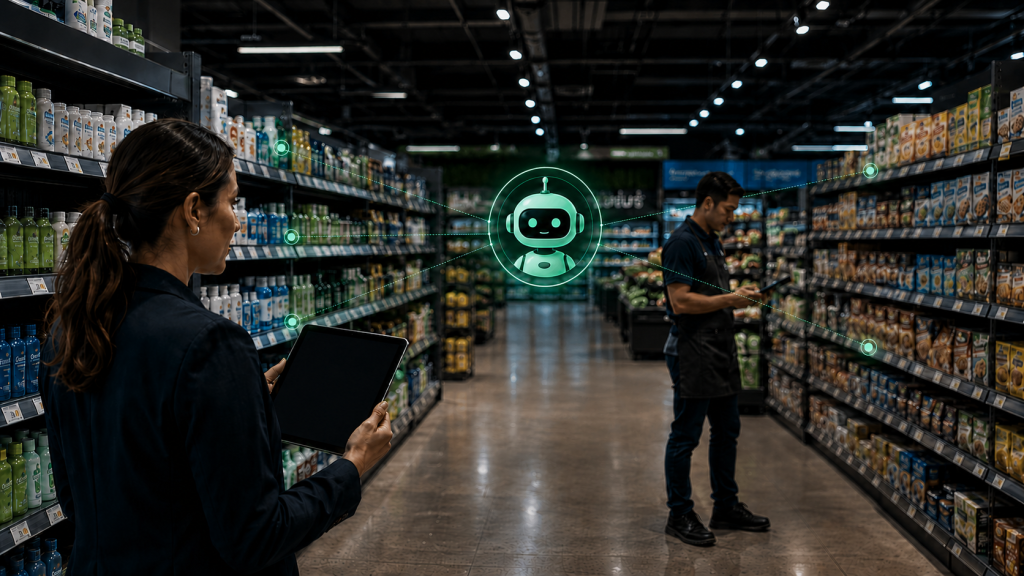
When someone asks which of your company’s systems are ready to connect to an AI agent, will you have an answer? The conversation about agents is already happening across retail. In boardrooms, technology teams, and operations departments. What remains unclear is what needs to be in place before taking that step.
Connecting AI agents to store operations starts with data. According to a 2026 Google Cloud report, 37% of retail executives already run more than 10 AI agents in their organization. Yet nearly two-thirds of companies worldwide have experimented with agents, while fewer than 10% have scaled them to deliver real value (McKinsey, April 2026). The gap is not in the AI models. It is in the infrastructure that feeds them.
The Real Problem: Store Data No Agent Can Use
An AI agent can reason, prioritize, and execute tasks on its own. But to do so, it needs access to reliable data from the system it operates within. In retail, that data lives in store operations: task completion records, audit logs, open incidents, photographic evidence from campaigns, and field visit history.
The problem is that most operational platforms were not built for external agents to use. They have no standard interface. They do not expose data in a format that agents understand. As a result, when a team tries to connect an agent to its store systems, it ends up facing a custom integration project that can take months to complete. McKinsey confirms it: 80% of companies cite data limitations as the main barrier to scaling AI agents.
The agent never reaches the store. It reaches the dashboard, the ordering system, and the customer service chatbot. But the physical operation, where real execution happens, is left out.
What It Takes to Connect AI Agents to Store Operations
For an agent to work with store data, it needs three things: to know how to access the system, to understand what it can do within it, and to receive data in a reliable format. None of the three resolves on its own.
1. Compatibility With an Open Standard
The leading agents on the market, including Claude, Codex, Cursor, and Gemini CLI, do not connect to proprietary systems by default. They connect through open standards that teach them how to operate a specific tool or platform. If an operational system does not follow that standard, the agent simply cannot use it, and someone has to build that connection from scratch.
That is why the first question worth asking is not “which agent do we adopt?” but rather: “Are our operational systems compatible with agents via an open standard?”
2. Quality Data, Not Just Available Data
Connecting an agent to fragmented, incomplete, or unstructured data produces unreliable results. The agent reasons from what it receives, and if what it receives is poor, its decisions will be too. In retail, field data has specific characteristics that make it especially valuable for an agent: it is captured in real time, includes photographic evidence, includes GPS location, and is tied to specific tasks and people.
In other words, it is auditable data. And that is exactly what an agent needs to act without guessing.
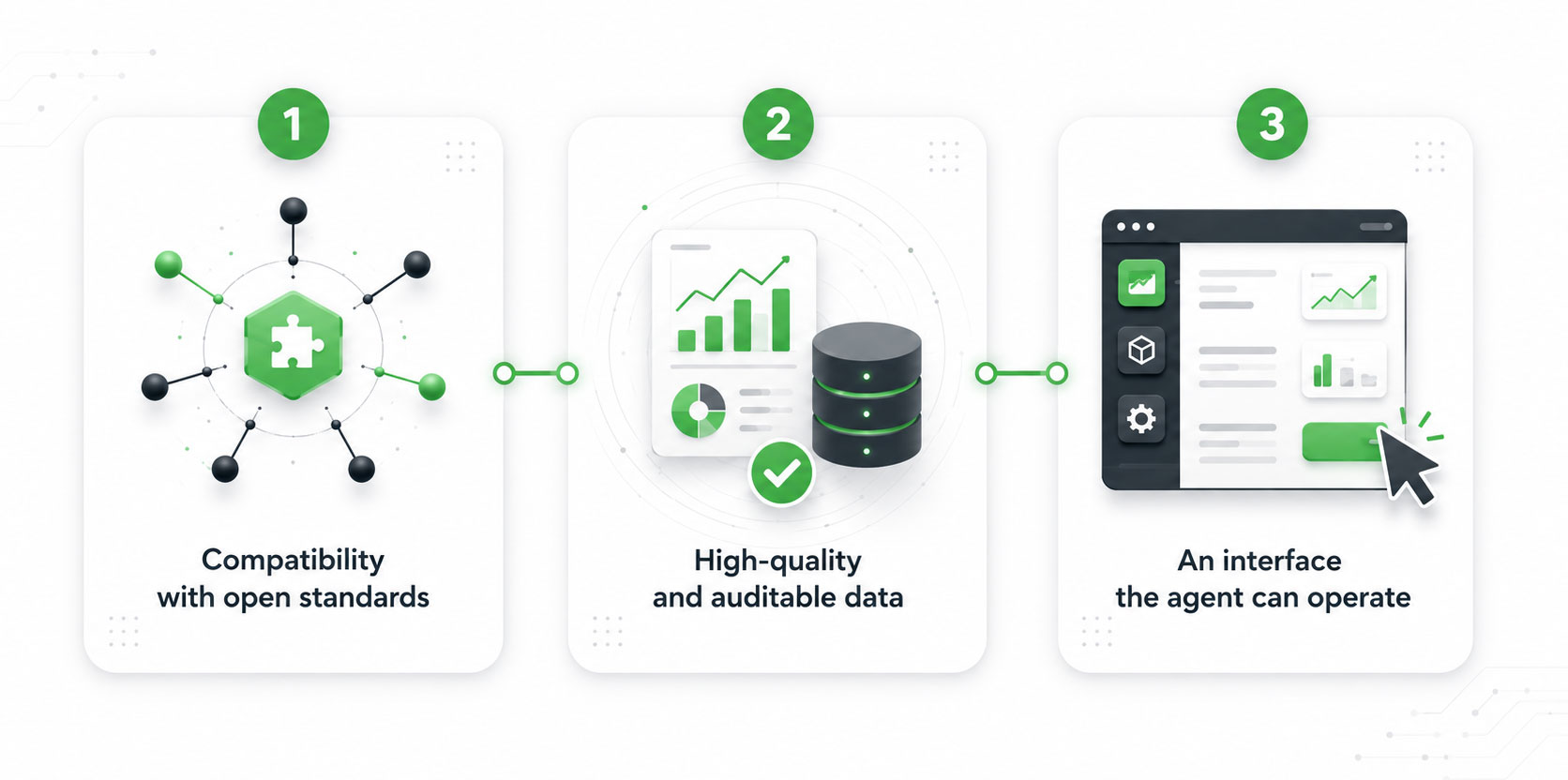
3. An Interface the Agent Can Operate
Beyond accessing data, the agent also needs to execute actions: create a task, escalate an incident, and review campaign compliance. For that, the operational platform must have an interface that the agent can understand and use autonomously. Without that interface, the agent can read but not act. And an agent that only reads automates nothing.
How to Connect AI Agents to Store Operations Without Months of Development
NRF 2026 delivered a striking figure: 61% of retailers say their organization is not ready, or only marginally ready, to scale AI in merchandising operations (SAP / NRF, January 2026). The bottleneck is not the agent. It is the systems the agent is supposed to use.
The most efficient solution is not to build a custom integration every time a new agent is adopted. It is to use operational platforms that are already compatible with the standards agents understand. That way, when the team decides to adopt an agent, the connection to store data is already in place.
Platforms that follow open standards like Agent Skills allow any compatible agent, whether Claude, Codex, Cursor, or Gemini CLI, to learn how to operate the system without the IT team having to build that connection from scratch. The agent loads its instructions, accesses store data, and can execute actions within defined limits. No months-long projects.
What It Means to Have Store Data Ready for Agents
Frogmi is a retail execution platform built on field data: completed and pending tasks, scored audits, escalated incidents, real-time photographic evidence, and GPS location data from field teams. All of that data is structured, auditable, and reflects what is happening in the store at the moment it happens.
Frogmi’s CLI is also agent-friendly. It follows the open Agent Skills standard, the same one used by Claude, Codex, Cursor, and Gemini CLI. That means any compatible agent can operate Frogmi without a custom integration. The IT team does not build the bridge. The bridge already exists.
For operations leaders, this means something concrete: your AI agent can already read your store data in Frogmi and act on it. There is no need to wait months for an integration or to rebuild what you have already put in place. The work you invested in digitizing your operations does not become obsolete. What your team runs in Frogmi becomes the foundation on which the agent acts.
Are Your Store Systems Ready for an Agent?
That is the question worth asking before choosing an agent. If the answer is that data is fragmented, that the platform has no standard interface, or that connecting an agent would require months of development, the problem is not the agent. It is the operational layer.
Preparing store data before adopting an agent is not an optional step. It is the step that determines whether adoption delivers real value or remains another pilot that never scales. Find out how Frogmi can be that ready layer for your agent.


