


 6 minutos de lectura
If one of your stores reports 100% store compliance month after month, it deserves a second look. The perfect store is a useful north star, but it does not exist as a constant. The reason is simple: a store is alive. People come and go all day, people run it, shifts change, customers move products around, prices get updated, and the list goes on. A space that reshapes itself every hour cannot stay flawless over time.
So the suspicious number is not a single 100%. It is 100% installed as the standard, repeated month after month. A dashboard that’s all green usually measures intent to respond. That’s different from the task actually getting done, and very different from what the customer experiences on the sales floor.
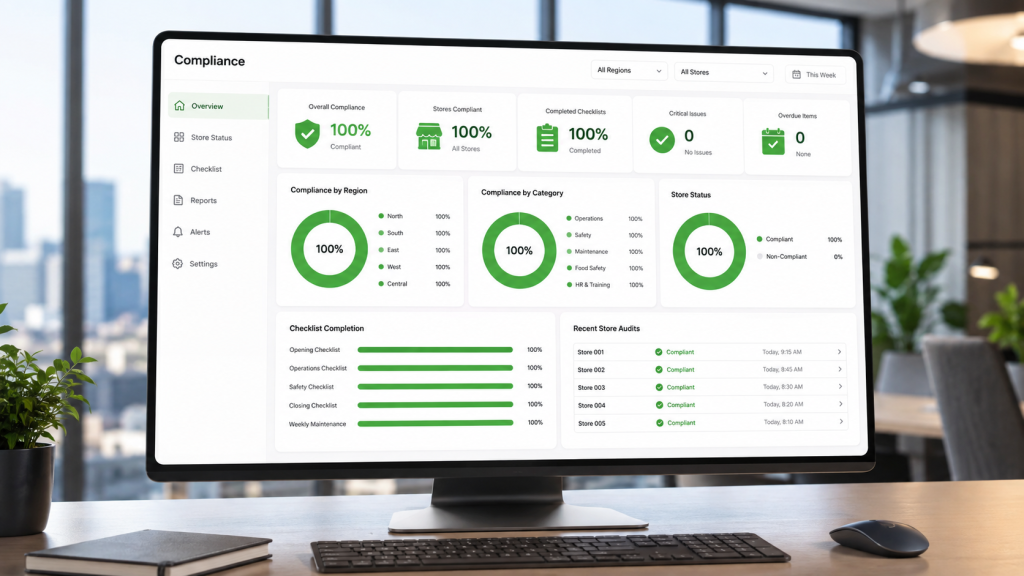
The green dashboard says more than it seems
This pattern repeats in chains of every size. It’s Monday. The store manager has fourteen assigned tasks, three of them new, and a shift running two people short. By six p.m., the checklist has to be closed. They mark what they saw, assume what probably got done, and close it out, because taking care of the floor matters more than filling out a form.
So the result reaches headquarters as 100% compliance: everything in order at the store. A dashboard that stays fully green, month after month, tells you the questionnaire is not working. It is not bringing back information anyone can act on. It stops being an achievement and becomes the first thing worth reviewing.
Variability, incidents, and deviations are part of the normal state of a store network. If the report does not show them, the diagnosis is not that operations are perfect. It is that the measurement is not capturing operations.
Why store compliance keeps hitting 100%
If everyone knows it’s impossible for everything to be perfect, why does 100% compliance keep showing up? Four causes repeat across chains of every size, and all four trace back to how the measurement itself is designed. Store teams respond with the time and information they have.
- Questions that answer themselves: “Did you check the display?” can be answered “yes” at no cost. “Do all three front-facing shelves show the correct price?” requires actually looking.
- Compound questions: “Is the display built, signed, and correctly priced?” asks someone to compress three separate realities into a single pass or fail. If two are right and one is wrong, there is no correct answer, and whoever fills it out picks whichever causes the least trouble. The data arrives impossible to interpret, because no one knows which of the three questions got answered.
- No evidence required: Without a photo, location, or timestamp, the answer is only the word of whoever filled it out. Nothing backs it up.
- Misaligned incentives: When compliance only exists to evaluate the store and never to help it, teams learn to protect the number.
There’s another, quieter factor: checklists keep growing. Every department adds its own questions, and no one removes the old ones. A sixty-item questionnaire at the end of a shift gets answered on autopilot, even when whoever fills it out means well.
When store compliance becomes a strategic asset
In the networks we work with, every checklist response comes with evidence. Under that standard, correct campaign execution runs around 84%. Response coverage reaches 98% across more than 1,500 stores.
That 84% is real, and it gives you something to act on. That is the whole difference. It tells you sixteen out of every hundred executions need attention. It tells you which stores they are in and lets you build the week around that.
At that point the data stops being a control report and becomes an asset for decisions. It shows where to send the field team, which format needs support, and which process needs a redesign. A 100% enables none of those decisions. An 84% tells you how much ground there is to close between the store you have and the store you are aiming for. That is the only practical meaning the perfect store idea ever had.
The cost of not knowing what actually happened
That gap between what gets reported and what gets executed shows up on the sales floor too. Bain documents it in The 2026 Retail Executive Agenda: 68% of customer detractions come from a negative experience. Put another way, two out of every three customers who wouldn’t recommend a retailer had a bad moment with the brand.
That experience is built from prices that don’t match, promotions that never showed up, and shelves left in disarray, exactly what a complacent checklist lets slide.
There’s an internal cost too, and it is the most expensive one: reaching the wrong conclusions. When the underlying information is poorly collected, every analysis built on top of it inherits the error in full.
The typical case is a promotion that underperforms. With a green checklist, the obvious reading blames the design of the promotion. The mechanic didn’t work, the price wasn’t compelling, or the message didn’t land. So the discount gets deeper, or the investment goes up for the next cycle. All of that is decided without any certainty that the promotion was installed, at the right price, in the agreed location.
That is how margin gets given away on a premise no one ever verified.
That error compounds with network size. In a ten-store chain, one visit settles the question. In a chain of three hundred, the report is the only contact with what’s actually happening on the floor. And if that report is inflated, every decision built on it, staffing, assortment, promotional calendar, and maintenance budget, ends up miscalibrated.
How to start measuring what actually happens on the floor
The good news: you don’t need to rebuild the entire control model. Four concrete moves change the quality of the data within a few weeks.
- Rewrite ambiguous questions and split compound ones. One question, one observable and countable task.
- Require evidence at critical points: a photo with the date, time, and location, rather than a description.
- Trim the checklist to the items that actually drive a decision.
- Escalate the finding to the support team that can resolve it, with an owner and a deadline, instead of leaving it as a note in a report. The store reports it, and the organization clears the way.
All four moves point in the same direction: a well written checklist drives the right behavior, because it delivers the standard inside the question itself.
That fourth move is the one that changes the culture. Once teams see that reporting a problem triggers real help, they stop protecting the number and start showing what is happening. That is the point where the store compliance you report and the one your customer experiences start to match.
This is where an execution platform makes the difference. At Frogmi, we connect digital audits with visual evidence and task management in a single workflow. That way, a finding automatically becomes an action with an owner, a deadline, and verification. Measurement stops being a month-end report and becomes the start of the work.
If you want to go deeper into how that workflow comes together, check out our article on retail operations management.
So, how many of your stores will report 100% this month?
Pick three of them. Check the evidence behind those answers and compare it to an unannounced visit. Whatever gap you find is the starting point for your execution plan. It’s probably also the most useful number you’ll have all year.


